Free Guide · 20 Min Read
Open Water
Swimming Guide
Everything you need to know about open water swimming for triathlons. From pool swimmer to confident open water athlete. Tips from Ironman Wisconsin and Chicago lakefront training.
Pool to Open Water.
If you can swim 2,000 meters in a pool, you have the fitness for open water. But fitness is only half the equation. Open water swimming is a completely different skill set. The pool is controlled: lane lines, a black line on the bottom, walls to push off, clear water, and a consistent depth. Open water has none of that.
In open water, you're navigating murky water where you can't see the bottom. There are no lane lines to keep you straight. Waves push you off course. Other swimmers are kicking and grabbing at you. The bottom drops away beneath you. It's uncomfortable, disorienting, and honestly a little terrifying the first time.
And that's exactly why you need to practice it before race day. The swimmers who panic in the Ironman swim are almost always the ones who only trained in a pool.
Pool
Lane lines, clear water, walls, black line, controlled temp, solo
Open Water
No lines, murky water, no walls, waves, variable temp, crowds
Pro Tip
Wetsuit Selection & Fitting.
Wetsuit Swim Exit
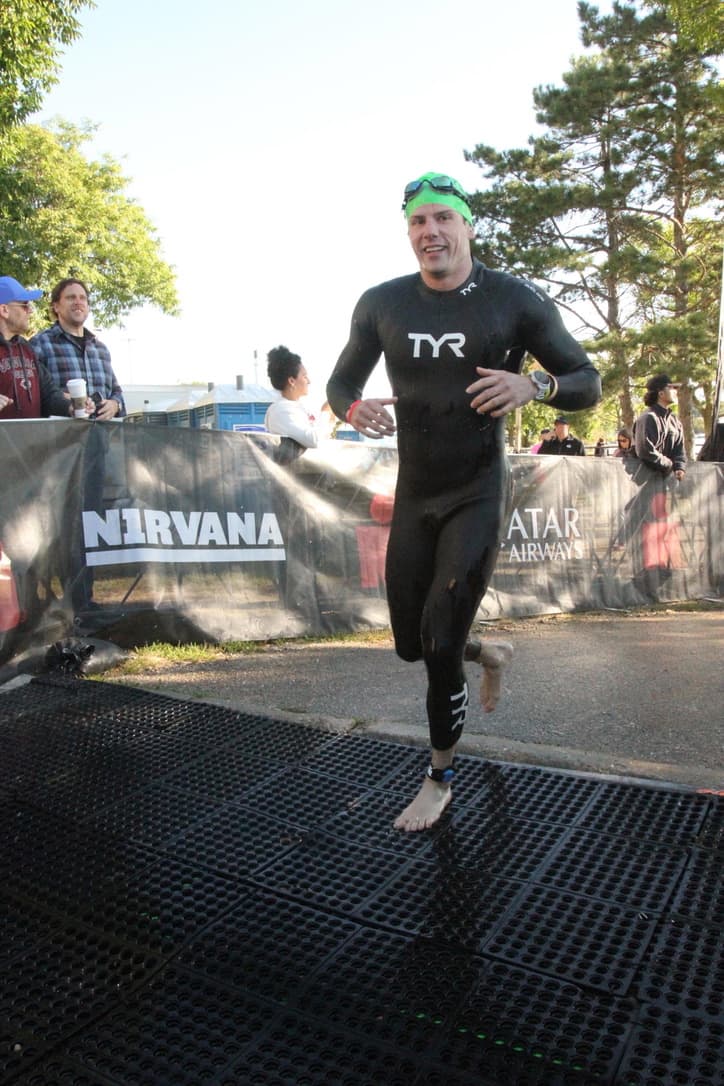
A triathlon-specific wetsuit is one of the best investments you'll make as a triathlete. It adds buoyancy (making you faster and more efficient), keeps you warm in cold water, and provides a psychological safety net. A good wetsuit can take 5-10 minutes off your Ironman swim time.
Triathlon vs. Surfing Wetsuits
Do NOT use a surfing wetsuit for triathlon. Triathlon wetsuits are specifically designed with flexible shoulder panels for the overhead swimming motion, thicker neoprene in the core for buoyancy, and thinner material in the arms and legs for range of motion. A surfing wetsuit will restrict your stroke and gas you within 200 meters.
Fit Is Everything
A wetsuit should fit like a second skin: tight everywhere with no air pockets, but not so tight that it restricts breathing or shoulder movement. The neck seal should be snug but not choking. Water should not be flushing in and out freely. When trying on a wetsuit, do swimming arm motions for 2-3 minutes. If your shoulders fatigue quickly, it's too tight in the chest and shoulders.
Rent First
For your first triathlon season, rent a wetsuit ($75-150 for the season or $50-80 for a single race). This lets you figure out what size and style works without dropping $300-600 on a suit that might not fit right. Many local tri shops and online services offer rental programs.
Pro Tip
Sighting Technique.
Sighting is the single most important open water skill. Without lane lines, your body naturally drifts off course. Most swimmers veer to one side without realizing it. Over 2.4 miles, bad sighting can add 200-400 extra meters to your swim. That's 3-7 minutes of free time lost.
How to Sight
The crocodile eyes technique. Lift your head just enough to get your goggles above the waterline, like a crocodile. You don't need to see perfectly. You just need to locate the next buoy or landmark. Then immediately drop your head back down and resume your stroke.
Integrate with your breathing. Sight forward, then rotate to breathe. This creates one fluid motion: eyes up, spot the buoy, head turns to breathe, resume stroke. Practice this as a drill in the pool.
Sight every 6-10 strokes. In calm water, you can sight less frequently. In choppy water or crowded conditions, sight more often. The cost of a few extra sighting strokes is tiny compared to the cost of swimming 100 meters off course.
Use landmarks, not just buoys. Buoys are small and hard to see in waves. Find a tall, stationary landmark behind the buoy: a building, a tree, a flagpole. Aim for the big target and you'll naturally hit the buoy.
Pro Tip
Drafting in Open Water.
Drafting is legal in the swim (unlike the bike in non-drafting triathlons) and it's one of the biggest free speed gains available. Swimming in the wake of another swimmer reduces your energy expenditure by 18-25%. That's massive over 2.4 miles.
Drafting Positions
The most effective position. Swim with your head near the lead swimmer's feet. You ride in their wake like a cyclist in a peloton. The downside: you may get kicked in the face.
Swim at the lead swimmer's hip, slightly behind. Less energy savings than feet drafting, but you can see where you're going and you won't get kicked. Good for congested starts.
Draft off someone who's already drafting. Still significant savings. Works well in large groups where getting to the front isn't possible.
To find a good draft, look for someone swimming at your pace or slightly faster. Tuck in behind their feet and match their stroke rate. If they're too fast, you'll burn more energy trying to keep up than you save from drafting. If they're too slow, you're better off on your own.
Pro Tip
Waves, Current & Chop.
Pre-Swim Prep
Flat, calm water is a gift. Don't count on it. Lake Monona at Ironman Wisconsin can get surprisingly choppy. Ocean swims are even more variable. You need to be comfortable swimming when the water is fighting you.
Swimming in Chop
Increase your stroke rate. In choppy water, a longer, slower stroke gets disrupted by waves. Shorten your stroke slightly and increase your turnover. More strokes per minute keeps you moving forward even when waves are pushing you around.
Breathe away from the waves. If waves are coming from the left, breathe to the right. This seems obvious but requires you to be comfortable breathing bilaterally. Practice bilateral breathing in the pool so you have the option on race day.
Stay relaxed. Tension is the enemy in rough water. If you tense up, your stroke falls apart, you waste energy, and you start swallowing water. Focus on keeping your hands relaxed, your jaw unclenched, and your kick light.
Dealing with Current
If you're swimming against a current, angle slightly into it to maintain your line. Swimming directly against a strong current is exhausting. Angle into it at 10-15 degrees and let your forward motion carry you toward the target. With a following current, relax and enjoy the free speed. Sight less often since the current is pushing you forward.
Pro Tip
Cold Water Acclimation.
Pool water is a comfortable 78-82 degrees. Open water can be anywhere from 55 to 78 degrees depending on location and time of year. The cold shock response when you first enter cold water is real: rapid breathing, elevated heart rate, and a panicky feeling. If you've never experienced it, it can cause a full-blown panic attack on race morning.
Acclimation Protocol
End every shower with 60-90 seconds of cold water. Focus on controlling your breathing. This trains the cold shock response in a safe environment.
Get in the lake or ocean for 5-10 minutes. Don't worry about swimming hard. Just float, tread water, and get comfortable with the temperature.
Build up to 20-40 minute swims in open water. Your body adapts. What felt freezing in week 3 will feel merely cool by week 7.
If possible, swim the race venue 1-2 days before. Even a 10-minute swim eliminates the shock factor on race morning. Your body already knows what to expect.
Pro Tip
Breathing in Choppy Water.
Breathing is the number one source of anxiety for open water swimmers. In the pool, you turn your head and there's air. In open water, you turn your head and there might be a wave. Swallowing water mid-stroke triggers a panic response that can spiral quickly.
Breathing Strategies
Exhale fully underwater. Many swimmers hold their breath and try to exhale and inhale in the same short breathing window. This is a recipe for hyperventilation. Exhale steadily through your nose/mouth while your face is in the water so that when you rotate to breathe, you only need to inhale.
Breathe bilaterally. Being able to breathe on both sides gives you options. If waves are hitting your right side, breathe left. If you're drafting off someone on your left, breathe right. Train bilateral breathing in the pool even if you have a preferred side.
The wave trough technique. In moderate chop, breathe in the trough between waves. As a wave passes, there's a brief pocket of air in the dip behind it. Time your breathing rotation to catch this pocket. It takes practice but becomes instinctive.
If you swallow water, don't panic. It happens to everyone. Roll onto your back for 3-5 seconds, cough it out, catch your breath, and resume. You lose 10 seconds. It feels like the end of the world in the moment but it's nothing.
Pro Tip
Race Start Strategy.
The race start is the most chaotic part of any triathlon swim. Hundreds or thousands of athletes hitting the water at the same time. Bodies everywhere. Accidental punches, kicks, and elbows. Goggles getting knocked off. It's controlled chaos, and you need a plan.
Mass Start vs. Rolling Start
Mass Start
Everyone enters the water at once. Maximum chaos. Seed yourself based on your ability: fast swimmers up front, slower swimmers toward the back and sides. If you're unsure, go to the back. You can always swim around people. Getting trampled at the front is much worse.
Rolling Start (Self-Seeded)
Athletes enter in waves based on predicted swim time. Much calmer than a mass start. Be honest about your swim time when seeding. Starting in a faster wave means getting swum over. Starting in a slower wave means navigating around people.
Wave Start (Age Group)
Athletes start in groups by age or category, 3-5 minutes apart. Smaller groups mean less contact. Position yourself toward the front of your wave if you're a strong swimmer, sides or back if you're moderate.
The First 200 Meters
The first 200 meters are always the worst. Your heart rate spikes from the cold water and adrenaline. Bodies are packed tight. Sighting is impossible in the splash zone. Just survive the first 200 meters. Swim easy, protect your space, and let the field spread out. By 300-400 meters, you'll have room to breathe and find your rhythm.
Pro Tip
Training in Lakes & Ocean.
Group Open Water Session
Finding safe, accessible open water to train in is one of the biggest challenges for triathletes. Here are your options:
Lakes
The most common open water training venue for triathletes. Look for designated swimming areas with lifeguards. Many state parks and recreation areas have swim beaches. Join a local triathlon club. They often organize group lake swims with safety kayakers.
Ocean
Ocean swimming adds waves, currents, and salt water to the equation. If your race is in the ocean, you need ocean practice. Swim parallel to shore where you can stand up if needed. Never swim in the ocean alone. Understand rip currents and how to escape them (swim parallel to shore, not against the current).
Organized Group Swims
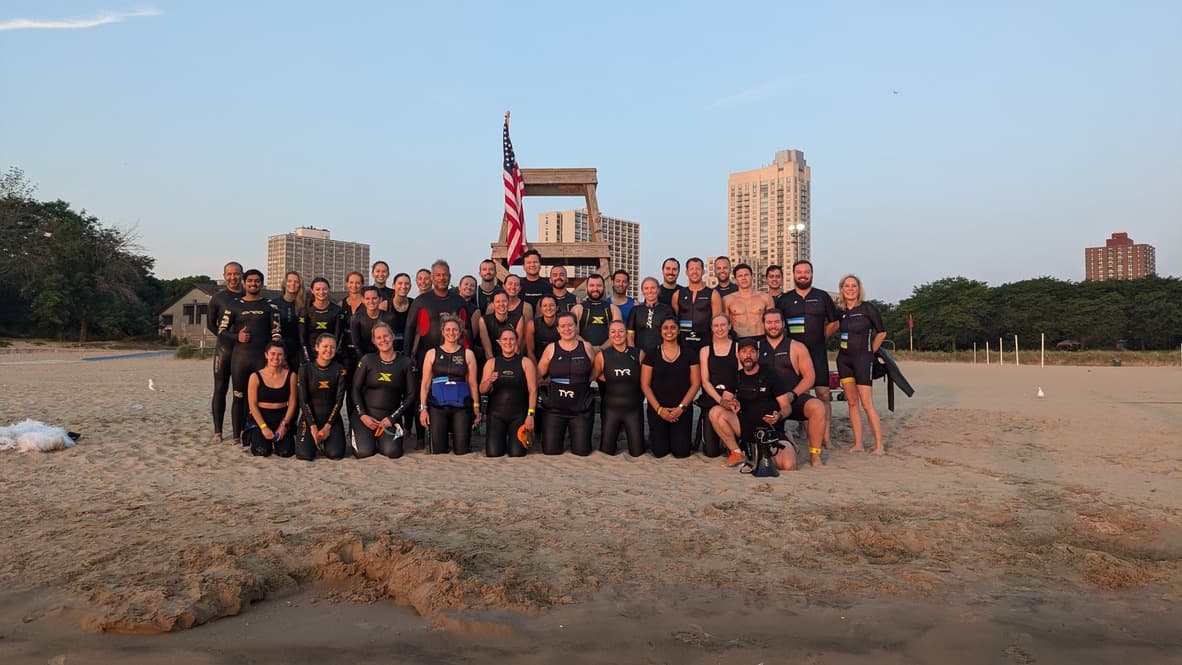
The best way to practice open water is with a group. Triathlon clubs, masters swim groups, and local organizations often host weekly open water sessions in the summer. You get safety support, people to draft off, and the experience of swimming near other bodies, which is exactly what race day feels like.
Pro Tip
Safety & Group Etiquette.
Open water swimming carries inherent risks that pool swimming does not. Respect the water. Every year, athletes have medical events during triathlon swims. Take safety seriously.
Safety Rules
Never swim alone. Always have a buddy, a kayaker, or someone on shore watching you. This is non-negotiable. No workout is worth the risk.
Use a swim buoy. A brightly colored inflatable swim buoy ($15-25) attaches to your waist and makes you visible to boats and watercraft. It also serves as a flotation device if you need to rest. Mandatory gear for training swims.
Know your limits. If the water is rougher than your skill level, don't get in. If you're feeling off or overly tired, skip the swim. There will be another day. Open water is not the place to push through “just one more” when your body is telling you to stop.
Check conditions. Water temperature, wave height, wind speed, and current conditions before every swim. Many beach and lake apps provide real-time conditions.
Group Swim Etiquette
Be aware of swimmers around you. Don't swim directly over someone slower. Go around. If drafting off someone, don't grab their feet. Communicate with hand signals or shouts if you need to stop. And always let the group know your planned route and turnaround point before getting in the water.
Pro Tip
Dylan's Open Water Tips.
Specific lessons from my Ironman Wisconsin swim and training in Lake Michigan and Chicago's lakefront. These are things I learned the hard way.
Practice in your exact race gear
Same wetsuit, same goggles, same swim cap, same tri suit underneath. On race morning you should have zero unknowns. I did at least 6 open water swims in my full race setup.
Bring two pairs of goggles on race day
Goggles break. Straps snap. Someone kicks them off your face in the washing machine start. Have a backup pair in your transition bag. I wore my primary pair and had a backup taped to my wetsuit collar.
Anti-fog your goggles the night before
Apply anti-fog spray or baby shampoo to the inside of your goggles the night before the race. Foggy goggles make sighting impossible, which makes navigation impossible.
Warm up your shoulders before the start
Do 5 minutes of arm circles, shoulder stretches, and light swimming if the warm-up area is open. Cold muscles plus cold water plus an aggressive start pace equals shoulder cramps at 400 meters.
The swim is just the beginning
Don't burn energy trying to PR the swim. Your goal is to exit the water feeling strong and calm, not gassed. Save your matches for the bike and run. A relaxed, efficient swim sets up your entire race.
Chicago lakefront for cold water training
Lake Michigan in May-June is cold. Like 55-60 degrees cold. Training there made Ironman Wisconsin's 70-degree water feel like a bathtub. Seek out cold water training if you can. It builds immense confidence.
Flip to backstroke when you need a break
There is no rule that says you must swim freestyle. If you need 30 seconds to catch your breath, flip to backstroke. You're still making forward progress, you can breathe freely, and your heart rate comes down. I did this twice during my Ironman swim.
That's The Guide
Now Get In the Water.
If this guide helped you, share it with a triathlete who's nervous about the swim. Follow along as I train for Ironman California 2026.
Track Your Training
Download InstaCal
The AI-powered calorie tracker I built. Dial in your nutrition to fuel your swim training and recovery.
Get InstaCal